

A character relationship chart connects people with labeled lines so you can check what holds between them at a particular point in a story. The useful question is specific: who is requesting something, providing something, or making an assumption about whom?
Start with the blank chart below, then follow a four-person example from Monday at 09:00 to one event at 12:00. You can copy the relationship table into ordinary writing notes and redraw the chart on paper. The characters, diagrams and event are original fictional materials. EchoMelon publishes this guide and operates an AI character roleplay product.
Start with a blank four-person chart
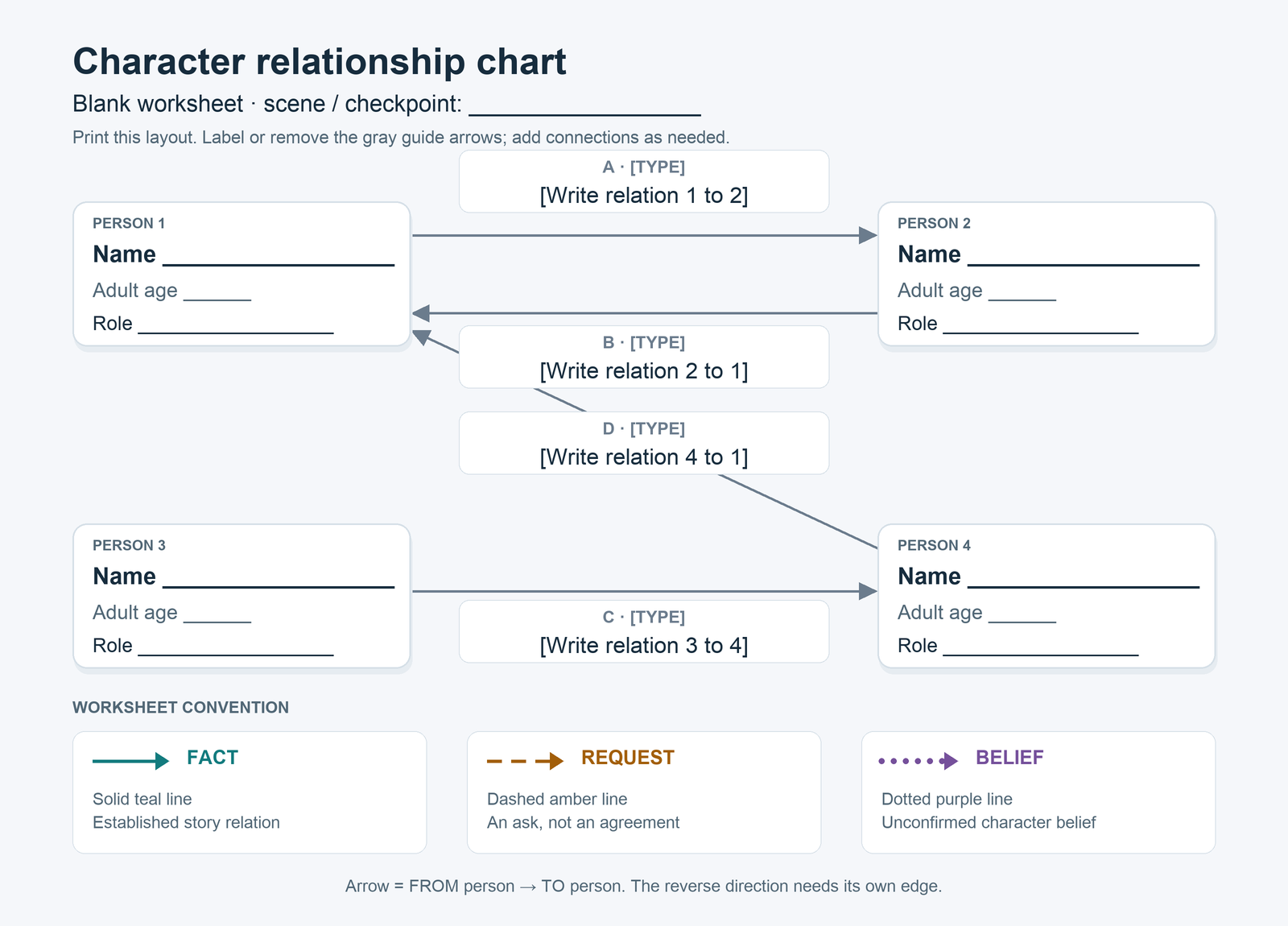
Open the full-size blank PNG to save or print it. Use the text table below for editable notes; the image itself is a static worksheet.
Give each person a separate box. Add a scene checkpoint above the chart before drawing connections. “Monday, 09:00” is more useful here than “Chapter 3”: you want to know whether a conversation or discovery has happened yet.
Copy this companion table and fill only the rows you need:
Chart title:
Scene checkpoint:

Person 1: name / role
Person 2: name / role
Person 3: name / role
Person 4: name / role

ID | FROM | TO | TYPE | SHORT LABEL | BASIS AT THIS CHECKPOINT
A  |      |    |      |             |
B  |      |    |      |             |
C  |      |    |      |             |
D  |      |    |      |             |
Each row becomes one arrow. The arrow starts at FROM and points to TO. Read the label in that direction. Four people do not need a line between every pair; an omitted line means you have not mapped that connection, not that the people have never met.
This is a worksheet you can adapt, not an online chart maker. Add people or rows when your story needs them. For the first pass, keep the cast small enough that you can read every label without tracing through several crossings.
Choose the cast and define the labels
Our example follows four adults connected to a community ferry:
| Person | Age | Role |
|---|---|---|
| Mara Vale | 34 | Community ferry coordinator |
| Oren Pike | 42 | Mechanic |
| Tess Quill | 29 | Radio operator |
| Ivo Hale | 51 | Ferry captain |
Names and roles are enough for this diagram. Keep appearance, voice and personal history in separate character cards; you can consult them without putting a biography inside each box.
Use three types for this worksheet:
- FACT: something established in this fictional story at the chosen checkpoint.
- REQUEST: something one person asks another to do; it does not establish completion.
- BELIEF: something a person thinks is true; it may remain unconfirmed.
These are our working labels, not a universal system. Put the type in text beside the relationship so the meaning survives a black-and-white printout. If you add colors or different line styles, explain them in a legend.
Labeled connections are a common approach: Milanote's relationship-map guide describes arranging characters and connecting them with lines, arrows and labels. Our table adds a place to record why each particular line belongs at this checkpoint.
Fill Scene A: Monday, 09:00
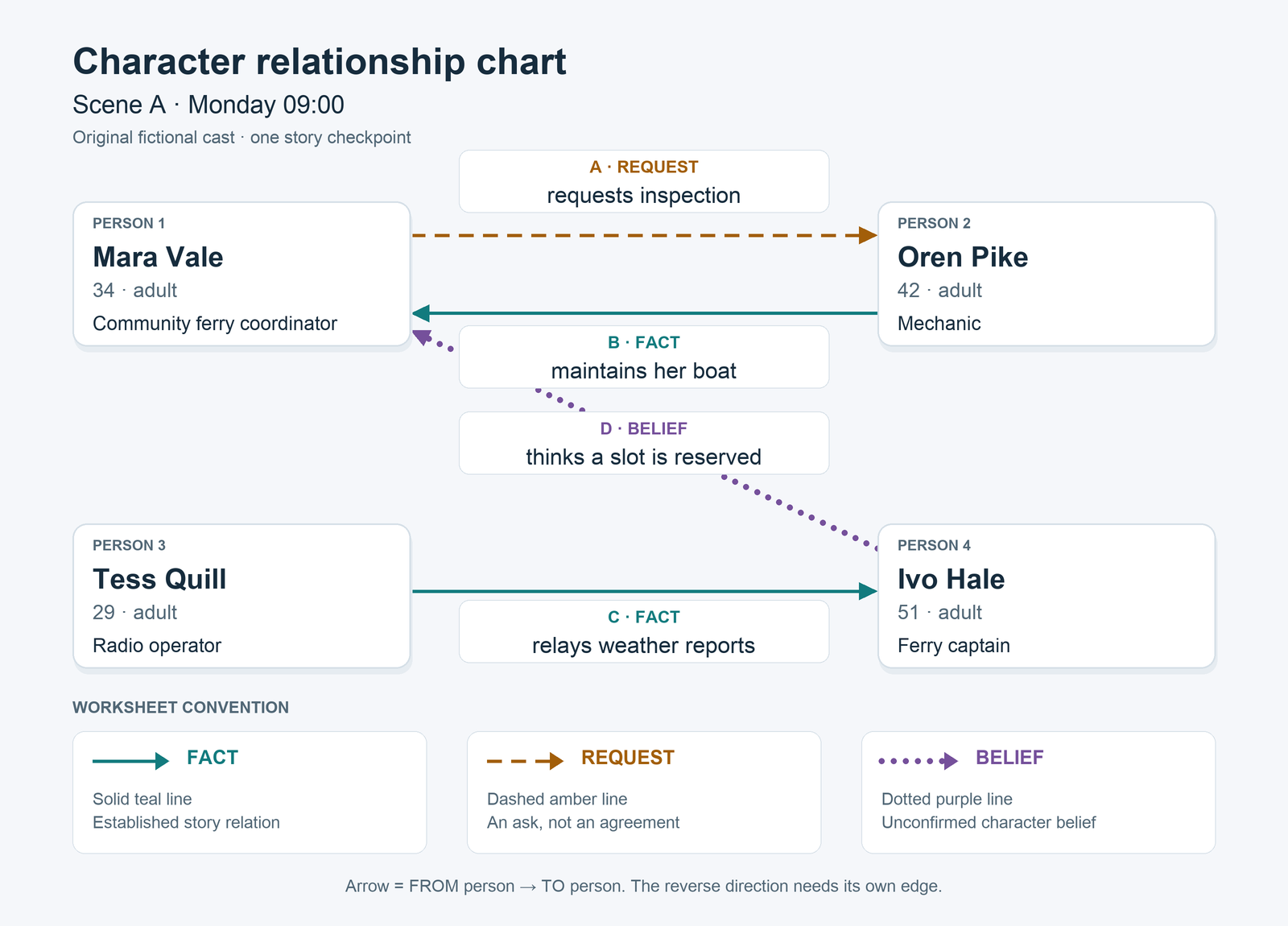
Use these four rows to reproduce the filled chart:
Scene A — Monday, 09:00

ID | FROM | TO | TYPE | SHORT LABEL | BASIS AT THIS CHECKPOINT
A | Mara | Oren | REQUEST | requests inspection | Mara has requested an inspection from Oren.
B | Oren | Mara | FACT | maintains her boat | Oren maintains Mara's boat.
C | Tess | Ivo | FACT | relays weather reports | Tess relays weather reports to Ivo.
D | Ivo | Mara | BELIEF | thinks a slot is reserved | Ivo holds this unconfirmed belief; a booking is not established.
Read A and B separately. Mara requests an inspection from Oren; Oren maintains her boat. The two arrows describe different things in opposite directions. Neither line says how warmly Oren feels toward Mara. Do not turn them into a single “trust” line because their work connects them.
C describes Tess's role in passing reports to Ivo. It does not establish a report's contents or a sailing decision. D records Ivo's belief about a reservation involving Mara. It does not say Mara agreed, that she knows he holds the belief, or that a slot has actually been booked.
Direction and uncertainty are already addressed in tools such as Prosematter's relationship-chart guide, which distinguishes one-way relationships and knowledge from suspicion. Here, the written BELIEF label keeps that distinction visible without requiring readers to decode a dotted line.
Before proceeding, trace each arrow against its row. A reversed arrow changes the statement even if the label stays the same. Also check that A and B remain individually readable wherever their paths run close together.
Update one line after an event
At Monday, 12:00, Oren gives Mara a signed completed inspection checklist. Mara accepts the completed inspection.
That is the entire event for this exercise. It establishes a completed interaction between these two people; it supplies no new information about Tess's reports or Ivo's supposed reservation.
Duplicate Scene A and name the copy Scene B — Monday, 12:00, after the handoff. Replace A with:
A | Mara | Oren | FACT | accepts his inspection | Oren gives Mara a signed completed inspection checklist; Mara accepts the completed inspection.
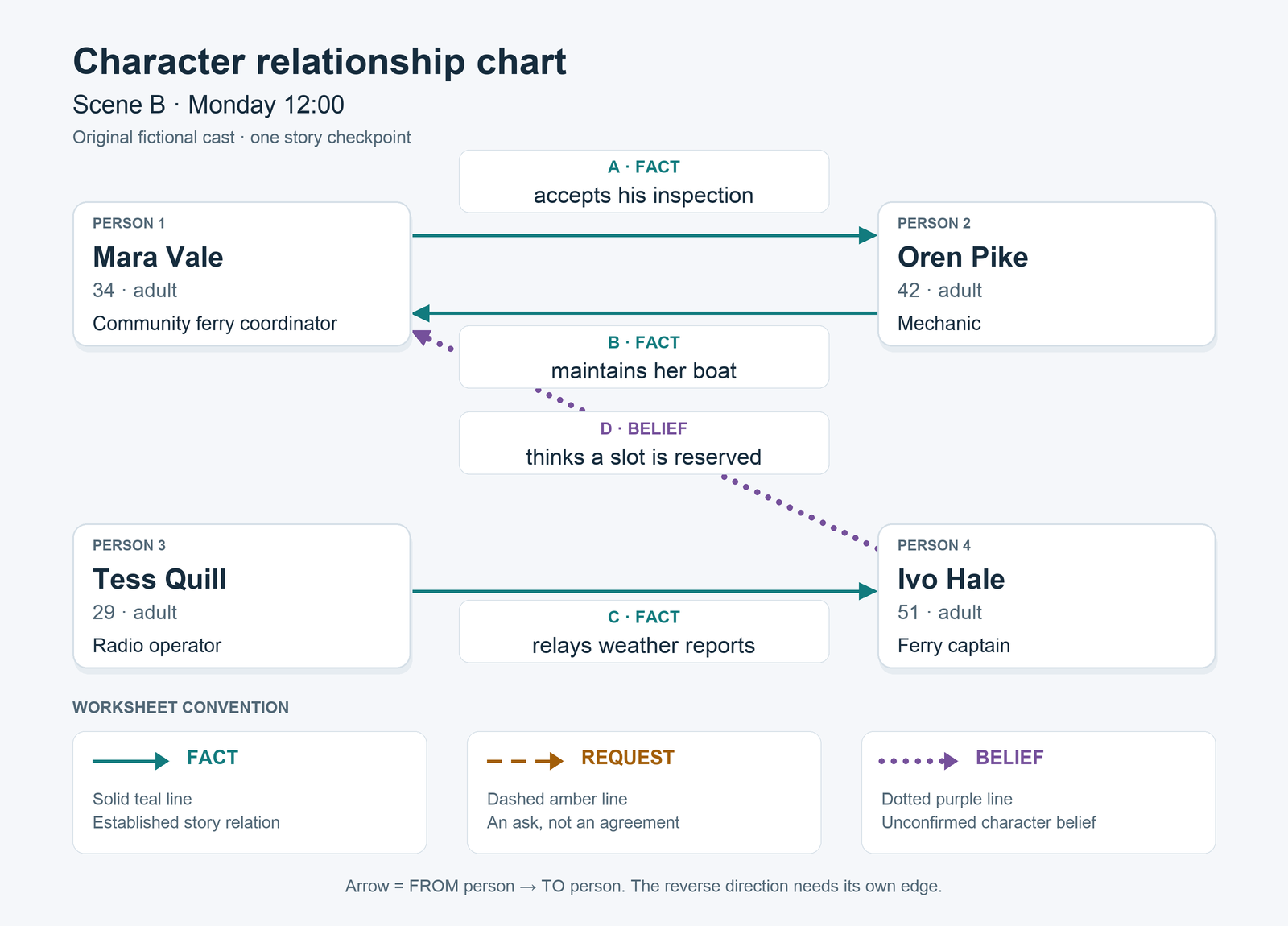
The direction remains Mara → Oren. Its type changes from REQUEST to FACT, and its label changes from requests inspection to accepts his inspection. B, C and D remain unchanged.
Keeping the earlier chart matters: it still answers what Mara was waiting for at 09:00. The new one answers where that interaction stands after noon. In this worksheet A records the latest state of that request. In a story where an old obligation and a new arrangement both remain active, you could keep separate rows instead of replacing one.
Compare the two versions before adding anything else. Did you accidentally confirm Ivo's booking? Add mutual trust? Reverse Oren's maintenance relationship? None of those changes follows from the written event. This fictional handoff is a continuity example, not a ferry inspection procedure.
Separate the chart from each character's knowledge
An author can see all four rows while a character knows only part of the situation. The noon event names Mara and Oren. It does not establish whether Tess or Ivo witnessed it or heard about it later. Leave that question open until you write the relevant information exchange.
For collaborative writing, identify which notes are shared story facts and which are private planning notes. For AI roleplay, choose the text you actually provide and check whether it still labels uncertain beliefs as uncertain. A diagram in your notes is not evidence that a model has received it, remembered it, or kept its contents separate from a character's knowledge.
When resuming after the handoff, a short story recap can record the event and A's changed state. Keep the chart for the overview; use the recap to explain the change. Neither format needs to repeat the entire cast's biography.
For your own chart, finish one checkpoint before planning the next. Every arrow should have a named source, a named destination, a readable label and a basis in what your story has established so far.
Comments
Join the discussionNo comments yet. Be the first to comment.